

The glutinous rice balls (known as "lo mai chi" in Cantonese) have long been a beloved local dessert. They feature a soft, stretchy outer layer (the skin) wrapped around sweet fillings like sesame, peanut, or mango. Recently, a pistachio-filled version has become a hit, attracting long queues of eager fans wanting to savour its delicate skin and rich filling. Yet, we all noticed how the chewy texture doesn't last. After just a few days or even a night in the fridge, the soft skin turns firm and loses its signature bounce. So, why is the soft, chewy texture of glutinous rice balls so short-lived?
The skin of glutinous rice balls is made primarily from a mix of glutinous rice flour and cornstarch. Both ingredients are rich in starch, a type of carbohydrate also found in foods like rice and potatoes. Starch is a polysaccharide formed by glucose units and is made up of two types of molecules: amylose and amylopectin. Amylose has a linear structure, while amylopectin is highly branched. The ratio of these two molecules affects the texture of starchy foods, the more amylopectin, the stickier the food. In glutinous rice flour and cornstarch, amylopectin makes up about 98% and 75% of the content, respectively.

To prepare the skin of glutinous rice balls, glutinous rice flour and cornstarch are mixed with water, milk, and coconut milk, which is then steamed to form a dough. As the dough heats up, the hydrogen bonds between the starch molecules break, loosening their tightly packed structure. Water seeps in and reforms the bonds, causing the structure to become disordered. This process, known as starch gelatinisation, makes the dough soft and sticky. After steaming, the dough is stirred to improve its texture. This helps the amylopectin molecules to intertwine and bind more closely together, giving the skin its signature chewiness.
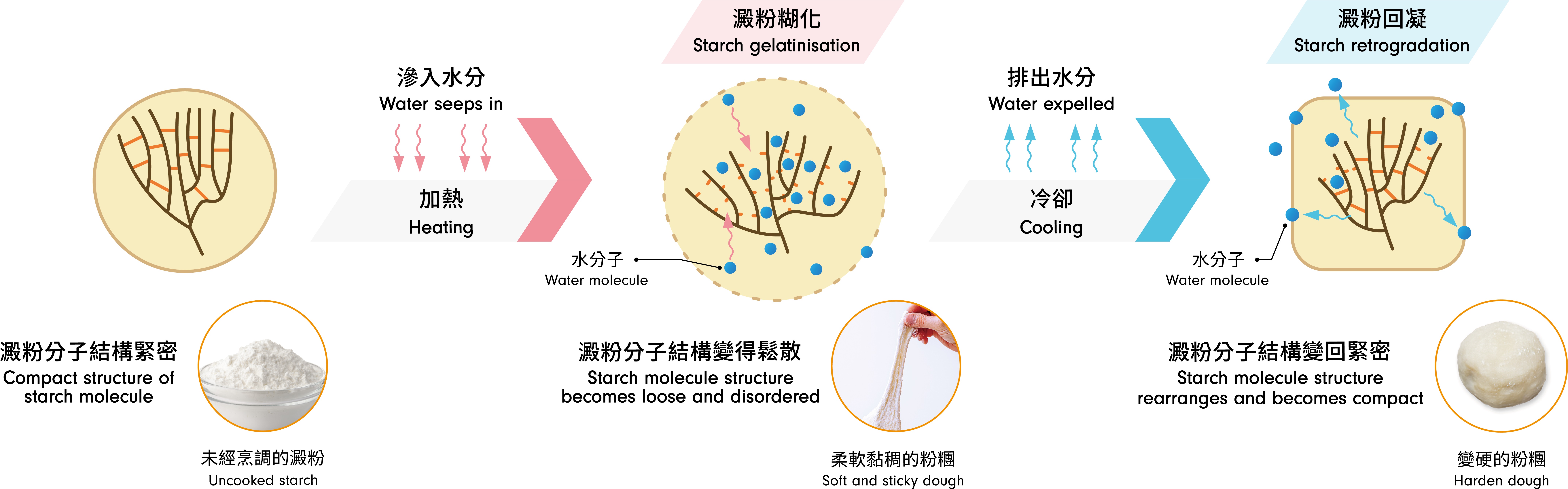
However, as the dough cools over time, the starch molecules gradually rearrange and form hydrogen bonds again, resulting in a more ordered structure and releasing water. This process, known as starch retrogradation, causes the soft and stretchy skin to harden. It's the same reason why cooked rice becomes firm when it cools or bread goes stale when left out. Storing glutinous rice balls in the fridge (at 2℃-10℃) speeds up this process and causes them harden even faster.
Some studies indicate that storing glutinous rice balls below 0℃ can slow down the interaction between starch molecules and help delay retrogradation. Glutinous rice balls are at their best when freshly made, offering a soft and stretchy texture. So, if you're seeking that perfect bite, the best advice is simply to enjoy them fresh! Do you have your own methods for preserving that just-made quality?