

Mother of Diamonds – Kimberlite?
Published on 31 August 2023
Many men choose to express their everlasting love and commitment to their partners by presenting them with expensive diamonds. In the current market, various companies have emerged offering one more option to them. These companies specialise in manufacturing synthetic diamonds through High Pressure and High Temperature (HPHT) techniques that replicate natural conditions or Chemical Vapor Deposition (CVD) processes, producing synthetic diamonds.
With the mass production of synthetic diamonds, they have become readily available for purchase. These lab-grown diamonds possess chemical structures and physical properties identical to natural diamonds, posing a challenge for diamond identification experts who must rely on special instruments to differentiate between the two.
For lab-grown diamonds, their "mother" could be the machines in a laboratory where they are created. As for natural diamonds, many people believe that they all originate from Kimberlite rock formations.
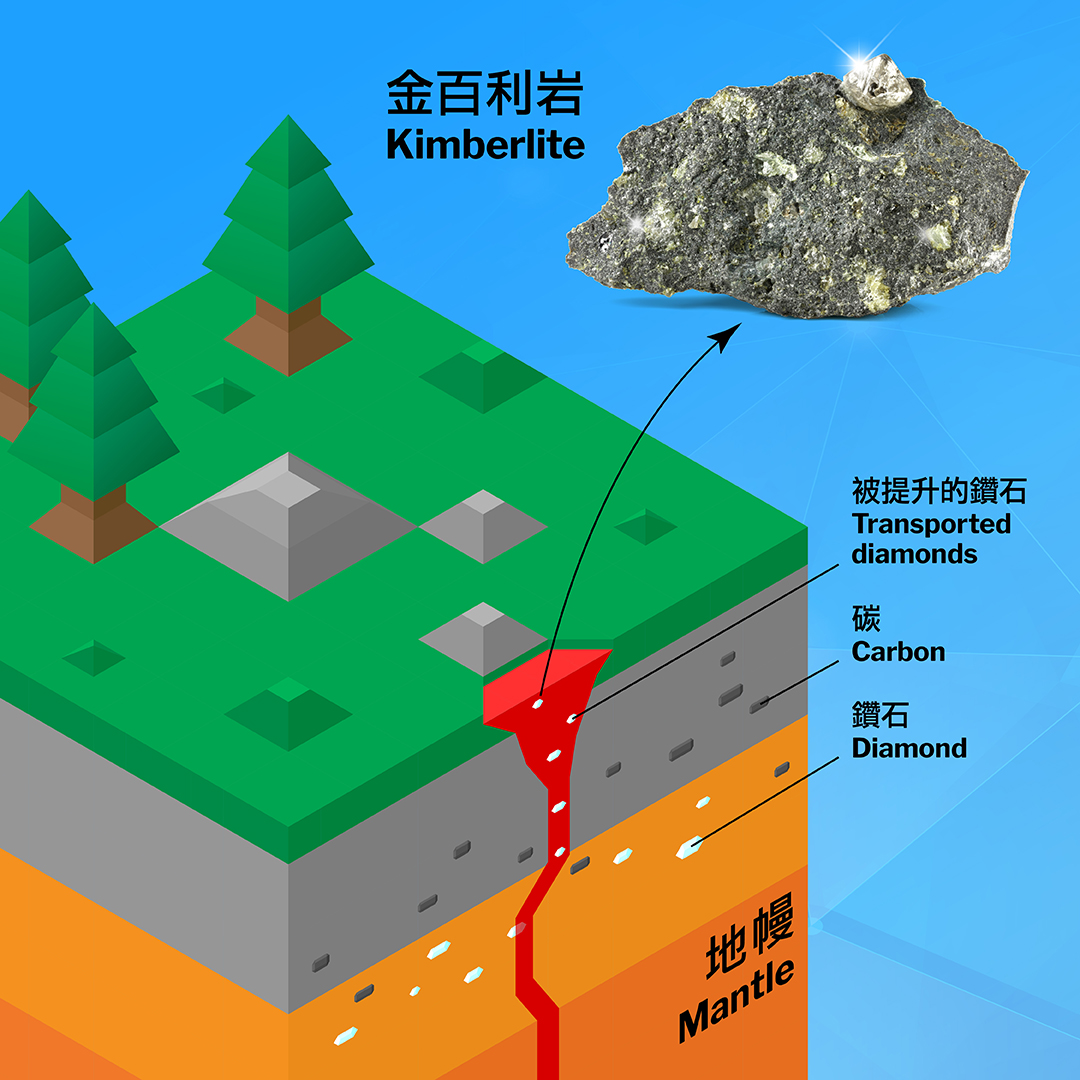
Kimberlite is one of the "porters" of diamonds, mostly found in continental cratons of Archean age (4-2.5 billion years ago). It is named after the place where it was first discovered – Kimberley, South Africa. Kimberlite may not necessarily contain diamonds, but because gem-quality natural diamonds are mostly found in kimberlite, it is the most well-known among diamond host rocks.
Kimberlite forms through the cooling of kimberlite magma, which originates from the high-pressure and high-temperature mantle. Because of a significant amount of volatile substances, it ascends rapidly towards the Earth's surface and erupts. During this process, it carries diamonds from deep underground. As a result, kimberlite structures predominantly take the shape of vertical funnel channels. The formation of kimberlite is often accompanied by a highly destructive phenomenon known as "pyroclastic flows", which can reach temperatures as high as 1,000 degrees Celsius. Pyroclastic flows consist mainly of hot gases from volcanoes and surrounding rock debris. They can move at high speeds on the ground, engulfing everything in their path.
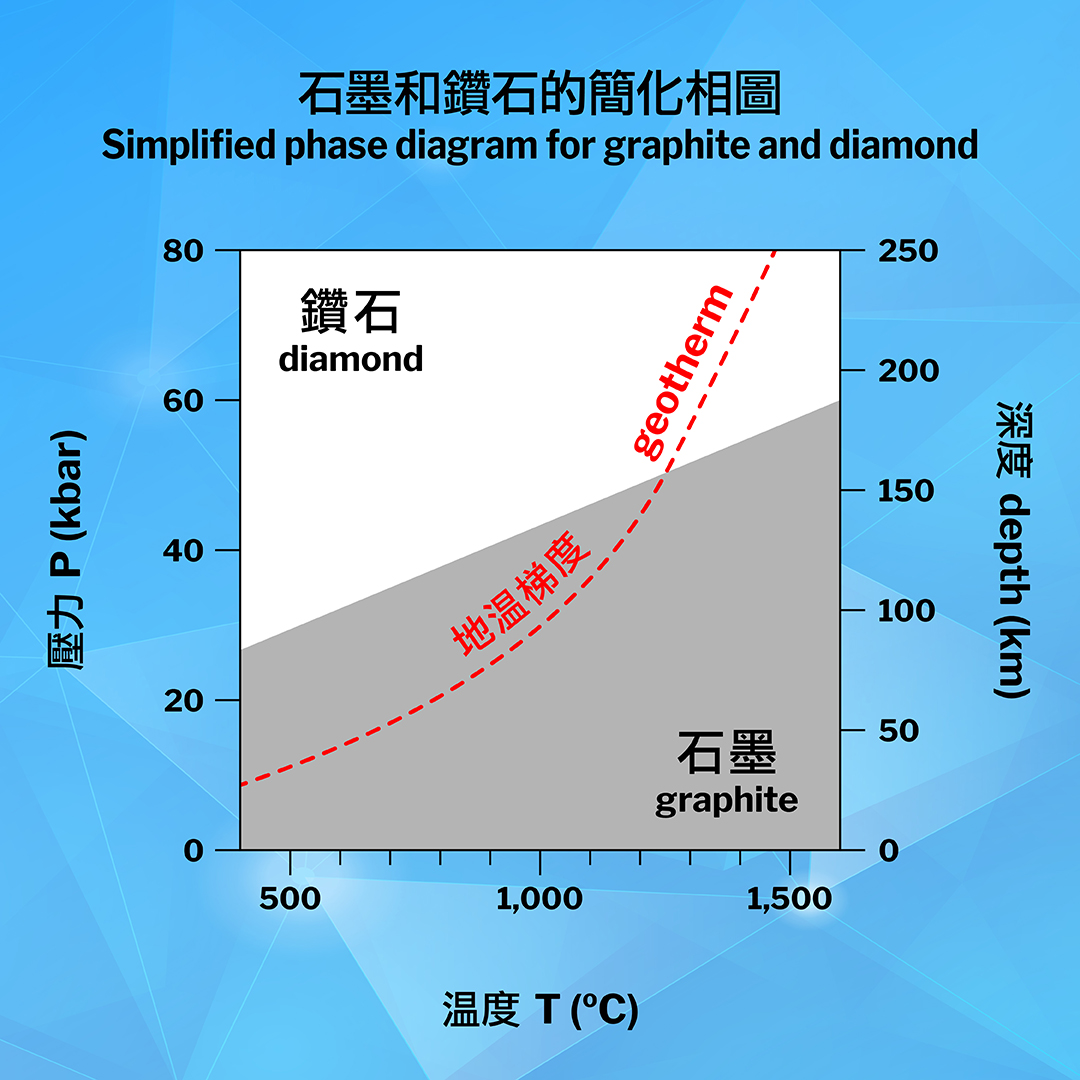
The chemical composition of igneous rocks could be related to the depth of their origin. Based on their silica content (SiO2), igneous rocks are categorised into basic, intermediate and felsic rock, depending on their increasing silica content. Geologists believe that as the temperature increases, minerals with high silica content melt first, leaving behind materials with lower silica content. These remaining materials will then slowly be separated from the felsic melt and sink deeper into the Earth. As a result, the low silica content tends to indicate the deep origin that the magma has. Kimberlite stands out as an ultramafic igneous rock, characterised by its relatively low silica content of approximately 30%. In contrast, granite, a rock type prevalent in Hong Kong, contains over 70% silica, indicating that kimberlite magma originates from much deeper regions than granitic magma. Typically, kimberlite is composed of a finely-grained matrix dominated by serpentine, altered from olivine. Additionally, it frequently contains minerals such as olivine, garnet and even diamonds.
Researchers from the University of Southampton employed geospatial and statistical analyses to ascertain that the emergence of kimberlite magma can be attributed to continental breakups. They propose that the fracturing of supercontinents results in convective instabilities in the mantle, which migrate across vast distances over millions of years, leading to the formation and eruption of kimberlite magma.